

0.37 to 0.68: The Numbers Behind India’s Best Para Games
One hundred and fourteen medals from 168 athletes at the Asian Para Games. The strike rate nearly doubled. Four Paralympic medallists were not on the plane. Both things happened, and together they ask a sharper question than either does alone.
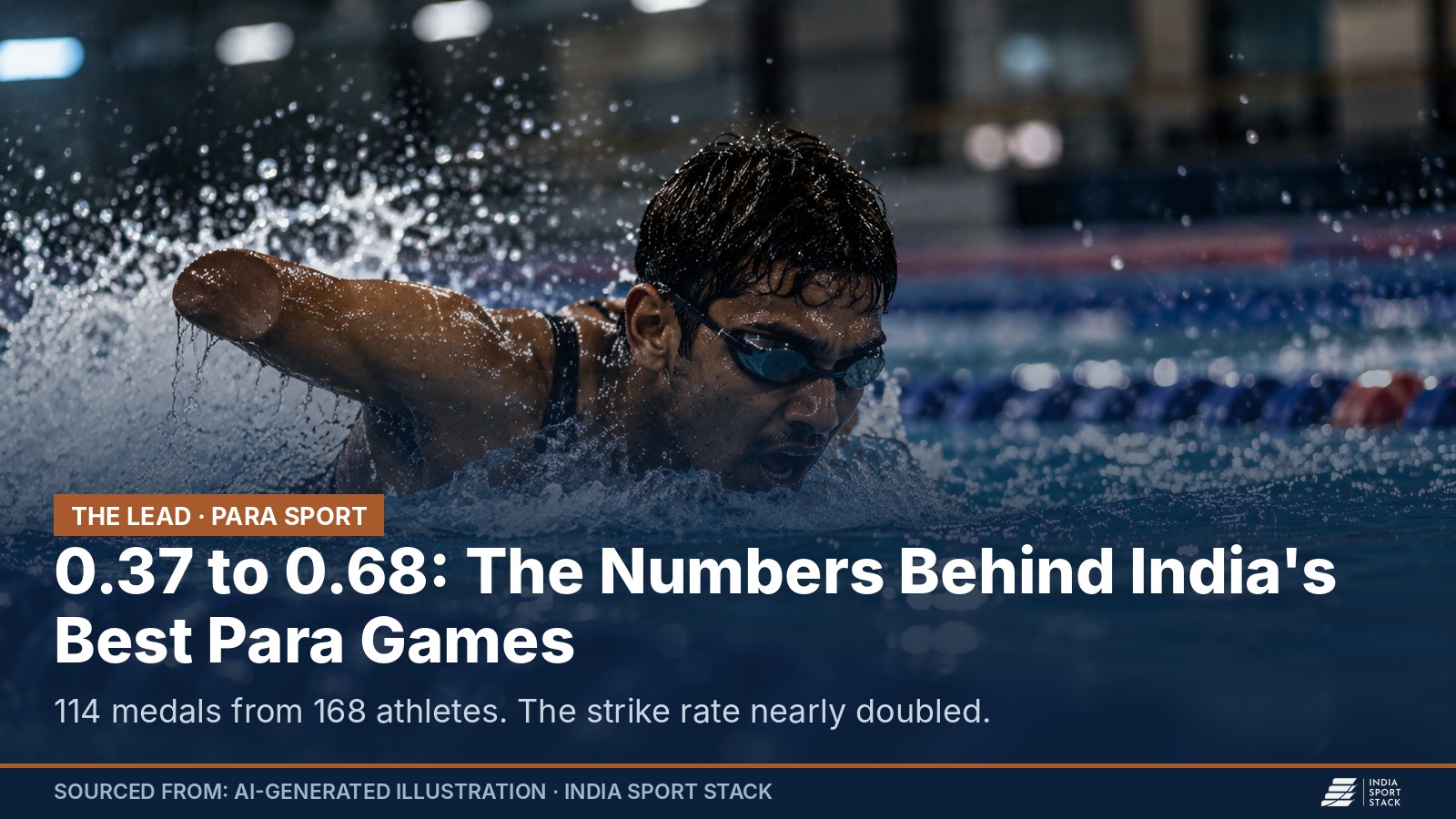
India finished fourth with 114 medals from 168 athletes, beating the Paralympic Committee of India’s own target of 90 to 100 by fourteen.
Measured per athlete, the conversion rate rose from 0.37 at Hangzhou to 0.68 — an improvement of about 85% on a squad cut by 45%.
The head coach of para athletics said on the record before the Games that four Paralympic medallists had not been selected. The cut worked. What it was for has not been explained.
India finished fourth at the 5th Asian Para Games in Aichi-Nagoya. Thirty gold, thirty-five silver, forty-nine bronze — one hundred and fourteen medals. The Paralympic Committee of India had set a target of 90 to 100. The team beat the top of that range by fourteen.
But the medal count is the easy part. The interesting number is the one you get when you divide.
India sent 168 athletes to Japan. It sent roughly 303 to China three years earlier. That is a cut of about 45%. A smaller team winning more medals is doing something right. The question is what.
Where the medals came from
Two disciplines carried the campaign, and one of them did something genuinely unusual.
Athletics produced 65 medals from 62 athletes. Swimming produced eleven, against one in 2022. These are not marginal gains. They look like a selection system that stopped sending people to make up numbers.
What it cost
The government disclosed the support figure and the headcount. The two numbers underneath are ours.
| Measure | Figure | Source |
|---|---|---|
| Government support for the contingent | USD 10.4m (INR 98.56 cr) | Disclosed |
| Athletes sent | 168 | Disclosed |
| Spend per athlete | USD 61,813 (INR 58.67 lakh) | Our arithmetic |
| Spend per medal won | USD 91,100 (INR 86.5 lakh) | Our arithmetic |
About INR 58.67 lakh per athlete, and a medal for roughly every INR 86.5 lakh. Measured against Olympic-cycle sports funding anywhere in the world, that is efficient. It deserves saying plainly, because the conversation around para sport rarely gets to the money at all.
The other account of the same campaign
There is a second version of what happened, and it comes from inside the camp. India’s para-athletics head coach, Satyanarayana Shimoga, said this on the record before the Games: “The one who has all the talent is not going to the team. Four Olympic medallists are not going.”
Read that against the result. India halved its squad, nearly doubled its strike rate, set a record — and left four Paralympic medallists at home while doing it.
Both can be true. A tighter squad lifts the average and can still leave medals uncollected. That is simply what a selection policy with a cost looks like.
So the useful question is not whether the cut worked. On the measure the Ministry will quote, it plainly did. The question is what the cut was for. If the squad was trimmed to raise quality, four proven medallists are a strange place to trim. If it was trimmed to control cost, then INR 98.56 crore for 168 athletes is a number to examine rather than applaud.
We went looking for the selection criteria published alongside the budget, and could not find them in our research. Until those two documents sit next to each other, both readings stay open.
Who paid for the shirt
This is where para sport’s position in the Indian market becomes visible.
| Contingent | Commercial partners |
|---|---|
| Asian Games (able-bodied) | Adani · BPCL · Amul — energy, infrastructure and FMCG |
| Asian Para Games (converted at 0.68) | SBI Life — one principal partner, value undisclosed |
Performance improved 85%. The commercial roster did not move. A record medal haul, delivered by the most efficient Indian contingent at any multi-sport Games, carried a single logo.
The state response follows a familiar shape — generous, quick, and entirely cash-based after the fact. Tamil Nadu committed about INR 2.2 crore across six medallists, including INR 30 lakh each to para table tennis players Baby Sahana Ravi and Jehan Madan. TN pays para medallists at the same headline rate as able-bodied ones, which is rare among Indian states and worth crediting. Karnataka raised its own cash awards on 3 October; the announcement does not mention para athletes.
Three funding layers, one gap
- Centre. Funds the trip. Publishes the total, not the per-athlete split.
- States. Pay for medals afterwards. Tamil Nadu at parity; Karnataka silent on para.
- The market. One insurer. No FMCG, no telecom, no energy, no automotive.
Every layer rewards the medal. None of them funds the pipeline that produced it — and the pipeline just got 45% smaller.
The cut raised the strike rate and it also left four proven medallists at home. Those two facts belong in the same sentence, and so far only the first one is being quoted.
Our position: publish the selection criteria alongside the budget. India has just produced the most efficient multi-sport campaign in its history and nobody outside the camp can say whether that was design or arithmetic.
The question for Indian sport
India has just run the most efficient multi-sport campaign in its history, and it did so by sending fewer people. That is a legitimate strategy. It is also a one-time gain. You can lift a strike rate by cutting the tail once. You cannot do it every cycle, because eventually you are cutting medallists — and this time, on the head coach’s own account, four of them stayed home.
Meanwhile a market that watched performance improve by 85% offered one insurance company.
If a smaller, sharper, cheaper team is now the model, who funds the athletes it leaves behind?
Whether the per-athlete funding split is published before the next selection cycle, and whether a second brand joins the para contingent before the 2027 season.