
Two Finals. Two Defeats.
India had never put two squash players into Asian Games singles finals on the same day. It did this week, and lost both. Across the four racquet sports India came home with seven medals and no gold, against four golds in Hangzhou. Eighteen months before squash enters the Olympic programme, that is the number to sit with.
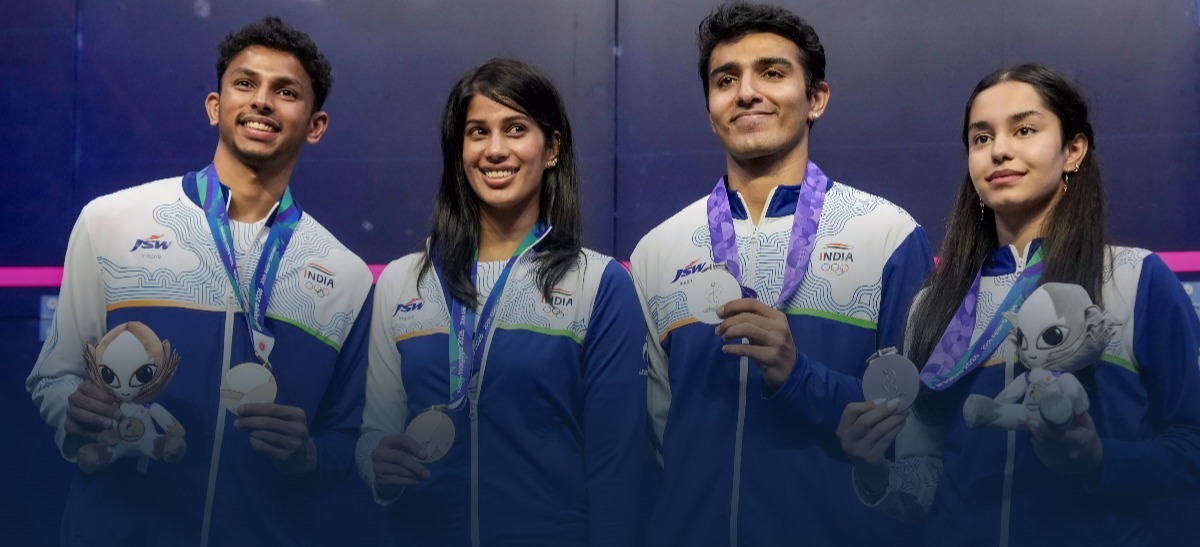

Anahat Singh is eighteen and the reigning world junior champion. Abhay Singh is the man who won India the team gold in Hangzhou from two match points down. Both reached their singles finals at these Games on the same day. No Indian squash generation had managed that before. Both lost.
Squash added three more podiums. Bronze for the women's team of Anahat, Joshna Chinappa and Tanvi Khanna. Bronze for the men's team of Veer Chotrani, Abhay Singh and Velavan Senthilkumar. And bronze for Chinappa and Senthilkumar in the mixed doubles.
Five medals from one sport. Not one of them gold.
Two historic finals and two defeats is not a bad week. Four golds becoming zero across four sports is a trend.
The racquet family, Hangzhou to now
| Sport | Hangzhou 2023 | These Games | What changed |
|---|---|---|---|
| Squash | Team gold (men), plus mixed doubles gold | 5 medals: silver, Abhay Singh (men's singles); silver, Anahat Singh (women's singles); bronze, Chinappa & Senthilkumar (mixed doubles); bronze, women's team; bronze, men's team | India reached further into the draw than ever and converted less of it. Two finals, two defeats |
| Badminton | Men's doubles gold; men's team silver | 1 medal: bronze, men's team | The doubles title that defined 2023 is gone; the depth behind it has not replaced it |
| Table tennis | Women's doubles bronze | 1 medal: bronze, Manush Shah & Diya Chitale (mixed doubles) | Beat the world No. 4 pair 3–1 in the quarter-final, then lost the semi to China's Wang Chuqin and Sun Yingsha in four straight. India's second-ever Asian Games mixed doubles medal in the sport |
| Tennis | Mixed doubles gold | No medal | Five players left out of the squad under the new selection criteria. India entered these Games with its thinnest tennis field in two decades |
| Four-sport total | 4 golds | 7 medals, 0 golds | More athletes in later rounds, fewer titles |
Squash, badminton, table tennis and tennis, India, 2023 versus 2026. Medal counts from official results; the tennis selection figure is from the federation's own squad announcement.
There is a genuine distinction hiding in that table, and it is the opposite of the one most reports reached for.
India did not get worse at racquet sports this fortnight. It got wider and less sharp. More players into quarter-finals and semi-finals. Fewer of them winning the last match. That is what a system looks like when it has successfully built a second tier and has not yet replaced its first.
The table tennis bronze is the week's most underrated result
Manush Shah and Diya Chitale beat Hong Kong's Wong Chun Ting and Doo Hoi Kem in the quarter-final. The scores were 11–6, 13–15, 11–9, 11–5. That pair are ranked fourth in the world.
That win was the medal. The semi-final against Wang Chuqin and Sun Yingsha went 8–11, 5–11, 8–11, 2–11, which is roughly what happens to everybody who plays them.
It is only the second Asian Games mixed doubles table tennis medal India has ever won, after Sharath Kamal and Manika Batra in 2018.
A bronze won by beating the world's fourth-best pair is not the same as a bronze that arrives through a kind draw. That is why it belongs in a story about underperformance rather than outside one. Indian table tennis has spent a decade being described as an opportunity nobody has taken. One pair beating a top seed does not settle that argument. It does make it worth having.
The tennis absence is a different problem
Squash, badminton and table tennis lost matches. Tennis did not turn up with its strongest available team.
Five players were left out of the squad under new selection criteria. India has a continuous Asian Games tennis medal history going back decades, and won mixed doubles gold three years ago. It took nothing at all.
We are deliberately not telling you whether the criteria were right. Selection rules exist to stop federations picking favourites, and a rule that produces an unpopular squad is not automatically a bad rule.
What we will say is narrower. A criteria change that removes five players from a squad, in the cycle immediately before an Olympic qualification window, is a decision whose reasoning should be public. As far as we can establish, it has not been published.
Why the next eighteen months matter more than this result
Squash enters the Olympic programme at Los Angeles 2028. India arrives at that moment with three assets. A world junior champion who has already contested an Asian Games final at eighteen. A men's player who has won a continental team title from match points down. And a women's team that held four match points in a semi-final and lost it.
That is the most commercially interesting position Indian squash has ever been in. It is also the most fragile.
Olympic inclusion changes a sport's funding category. It moves squash out of the discretionary column and into the one that attracts government support, corporate CSR allocation and the attention of agencies. The federations that are ready when that reclassification happens capture a decade of it. The ones still arguing about selection in 2027 do not.
A federation with two teenage finalists has roughly eighteen months to decide what to do with them. On the evidence of the tennis squad, deciding is the part Indian racquet administration finds hardest.
Four ways to read seven medals and no gold
Two Indians in two squash finals on one day is the best day the sport has had here. It also ended with two silver medals, and silver in a two-player final is a loss, not a result.
Anahat Singh is eighteen, with an Asian Games final behind her and an Olympic cycle in front of her. The athlete-level reading of this week is unambiguously good, provided the next two years are planned.
Four golds to zero across four sports in one cycle demands an explanation, and the tennis squad decision needs its reasoning published. Depth without conversion is an administrative outcome, not an accident.
Squash before an Olympic debut is the cheapest serious sponsorship in Indian sport right now, and it has two marketable teenagers. That window closes the moment the sport is on an Olympic programme and priced accordingly.
Is a racquet programme that reaches more finals and wins fewer of them improving or declining — and which of those two numbers would you fund?
Reply and tell us. We will publish the most interesting disagreement in Issue 02.
Where every number here came from
Both squash singles finals, and the five squash medals by event and athlete. The published Indian medal list for these Games, cross-checked against the Squash Rackets Federation of India's announcements. The “first time two Indians have reached Asian Games singles finals on the same day” claim is checked against India's squash medal history at the Games; we would welcome a correction if an earlier instance exists.
Table tennis: the quarter-final and semi-final scorelines, and the “second ever” claim. Agency match report of 25 September and the official scorecard. The historical comparison is to Sharath Kamal and Manika Batra's mixed doubles medal at the 2018 Games.
Four racquet golds in Hangzhou 2023; seven medals and no gold now. Official medal tables for both Games, counted by sport family rather than by discipline.
Five tennis players omitted under new selection criteria. The federation's squad announcement and its published criteria. We asked for the reasoning behind the change and have not received it. If it is provided, we will publish it in full.
Squash's inclusion at Los Angeles 2028 is from the IOC's published event programme for those Games. Corrections to anything above go up with a date on them, on a page that stays on this site permanently.
Written at the close of play on 3 October 2026.